Two units at the same price can cost very different amounts per usable square metre. How Hurghada areas are measured, and how to compare them fairly.
Every listing has a number that looks like the price, and a number that looks like the size. Divide one by the other and you have a price per square metre that feels objective. It usually is not.
Two apartments advertised at 120 square metres can differ by fifteen square metres of usable space. One may count the balcony, the wall thickness and a share of the corridor. The other may count the internal floor you can actually furnish. The price per square metre changes depending on which number you use, and the ranking between two units can flip.
The short answer
Compare net internal area, add any outdoor space at a stated weighting, and always ask what the advertised area includes. A price per square metre is only useful when both units are measured the same way. The brochure number is a starting point, not a basis for a decision.
The numbers behind one apartment
Most units carry several areas, and developers do not all define them the same way.
- Gross or built up area. The footprint of the unit, often including external walls, internal walls, shafts and sometimes a share of the common areas.
- Net internal or carpet area. The floor area inside the apartment that you can use, measured between the internal faces of the walls.
- Outdoor area. Balcony, terrace or garden. Sometimes excluded, sometimes counted in full, sometimes counted at a percentage.
- Common share. A proportion of corridors, stairs, lifts and plant rooms. It belongs to the building, not to your living room.
None of these is dishonest on its own. The problem starts when the headline area is used as if it were the area you will furnish, and the price per square metre is calculated from it.
Why the same size feels different
Two apartments of identical net area can live very differently.
- Layout efficiency. A long corridor, an awkward entrance or a large circulation zone takes space without adding a room.
- Wall thickness and columns. Structural elements reduce what you can place against a wall.
- Kitchen and bathroom positions. Services grouped together free up living space. Services spread across the plan create dead corners.
- Balcony depth. A shallow balcony is a rail. A deep one is a room in the warm months.
- Ceiling height. More height makes a smaller plan feel larger, and matters in summer.
- Storage. Built-in wardrobes and a store room change how much furniture the unit needs.
- Window and light. A well-oriented 90 square metres can feel better than a dark 110.
Area is a cost measure. It is not a comfort measure.
How to build a comparable number
Pick one method and apply it to every unit you are considering. A workable version is net internal area plus outdoor space at a stated weighting.
- Ask for the area breakdown in writing: gross, net, outdoor and common share.
- Confirm how the balcony or terrace is counted, and at what percentage.
- Add the net internal area to the weighted outdoor area.
- Divide the price by that figure.
- State the basis every time you compare, so you are not mixing methods.
If a developer will not provide the breakdown, measure the unit yourself from the plan or on site. Adding up the internal room dimensions takes ten minutes and tells you more than the brochure.
A worked example
The numbers below are illustrative, not current prices. They show how the ranking can change with the basis.
- Unit A. 2,000,000 for 120 square metres gross and 95 net. That is 16,667 per gross square metre and 21,053 per net.
- Unit B. 1,900,000 for 110 square metres gross and 92 net. That is 17,273 per gross square metre and 20,652 per net.
On the gross figure, Unit A looks cheaper. On the net figure, Unit B is cheaper. The difference is not the market. It is the definition.
Now add outdoor space. If Unit A has 18 square metres of balcony weighted at 50 percent and Unit B has 8 square metres at the same weighting, the usable totals become 104 and 96, and Unit A moves ahead. A deep terrace can be worth more than the internal area it replaces, but it should be compared on a stated basis, not folded silently into the headline number.
What the price should include
Area is only half of the comparison. The other half is what comes with it.
- Finishing level. Core and shell, semi-finished, fully finished or furnished. The same area can carry very different work.
- Kitchen. Cabinets only, or cabinets with appliances and a counter.
- Air conditioning. Included, or an extra cost after handover.
- Parking and storage. Included in the price, sold separately, or allocated by right of use.
- Outdoor space. A private garden or roof terrace can be a large part of the value and a small part of the area.
- View and floor. The same plan on a different side of the building is a different product.
Ask for the inclusions list in writing. A price per square metre that excludes the kitchen, the AC and the parking is not comparable with one that includes them.
What the contract should say
The contract is where the area becomes binding. Read the clause carefully.
- Which area is stated, and how it is defined.
- Whether the balcony, terrace, garden or parking is included, and at what weight.
- What tolerance is allowed between the stated and the delivered area.
- What happens if the delivered area differs, in price or in obligation.
- Whether the drawings attached to the contract match the unit you inspected.
- How the common share is calculated and whether it can change.
If the definition is vague, ask for it in writing before you sign. A number without a basis is a number you cannot enforce.
Measure before you commit
On a site visit, take a tape measure and check the rooms that matter.
- Measure the internal width and length of each room and add them up.
- Check the balcony depth and width, not only the total area.
- Compare the result with the plan and the contract.
- Photograph the plan and note the dimensions you measured.
- Ask which walls are structural, because they limit future changes.
If the unit is not built yet, ask for dimensioned drawings rather than a render, and confirm that the furniture shown is to scale. Renders frequently use slightly smaller furniture to make a plan feel larger.
Questions to ask
- What exactly does the advertised area include?
- What is the net internal area?
- How is the balcony or terrace counted?
- Is parking included, and is it a title or a right of use?
- What is the finishing level, and what is excluded?
- What tolerance does the contract allow on area?
- Can I see dimensioned drawings and the area calculation?
- How does this unit compare per net square metre with the one next to it?
The mistakes buyers make
- Comparing a gross area in one project with a net area in another.
- Treating the balcony as free space when it is priced into the unit.
- Dividing the price by the brochure area and calling it value.
- Ignoring layout efficiency because the number looks right.
- Forgetting that kitchen, AC and parking change the real cost.
- Not checking the area tolerance in the contract.
- Assuming a larger unit is always the better purchase.
You do not live in the gross area. You live in the rooms the plan actually gives you.
Where our releases sit
Al Arabia builds in Al Kawther in the south and Al Ahyaa in the north. For Mark Resort and Athena Resort, we provide the area breakdown for each unit, the dimensioned plan and the inclusions list, so you can compare the same basis across layouts and floors rather than a headline number. Talk to the team or compare the current releases.
For how orientation and outlook change the value of the same plan, read What a Sea View Is Actually Worth. For what should be in the unit when you receive it, read What Fully Finished Actually Means.
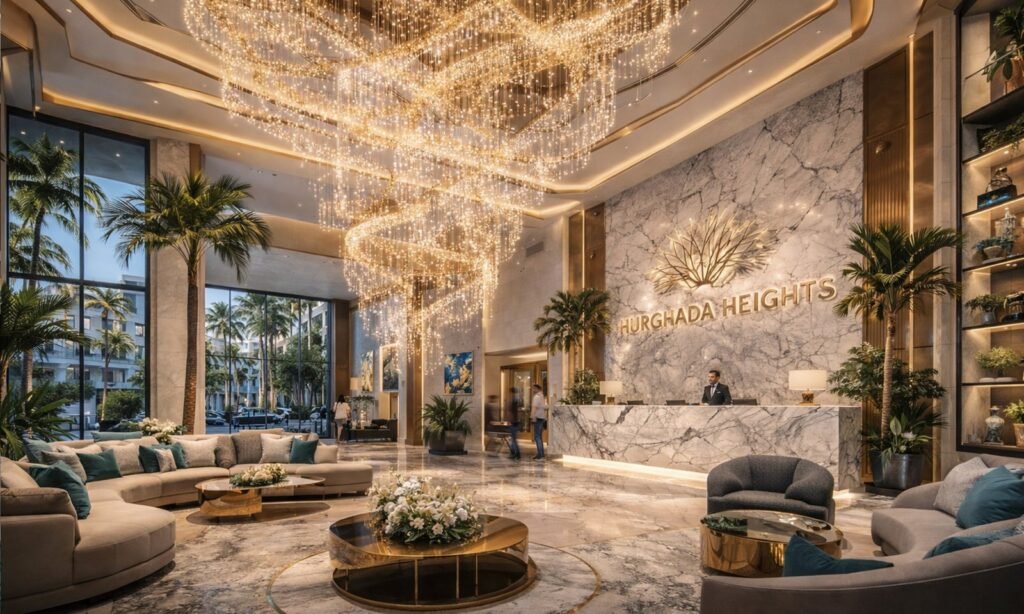
See it in our projects: Hurghada Heights and Lavanda Beach Resort are both selling now in Hurghada. For current units, prices and payment plans, message our team on WhatsApp.
Ready to talk it through?
Our team can walk you through the details for any of our communities.